What the Weather Here Does to It
Naperville sits in a cold, moderate climate band, which means the ground under your slab goes through a real freeze-thaw cycle every winter. That matters more than most homeowners think, because your safety sensors aren't mounted to the door or the frame - they're mounted to brackets bolted into the concrete apron near the floor, about six inches up on each side of the track. When the slab heaves even a little from frost, or settles back down in the spring thaw, the brackets move a fraction of an inch. The sensors don't need much to lose alignment. A shift of an eighth of an inch at the lens can be enough to break the beam intermittently, especially at dusk when low sun angle interacts with a lens that's already slightly off-axis. Add condensation - common on cold mornings when a heated garage meets outside air - and you get a film on the lens that mimics a real obstruction. None of this is a defect in the sensor. It's the building settling and the weather doing what cold-climate weather does, twice a year, every year, to a bracket that was never meant to be perfectly rigid.
When to Call Someone
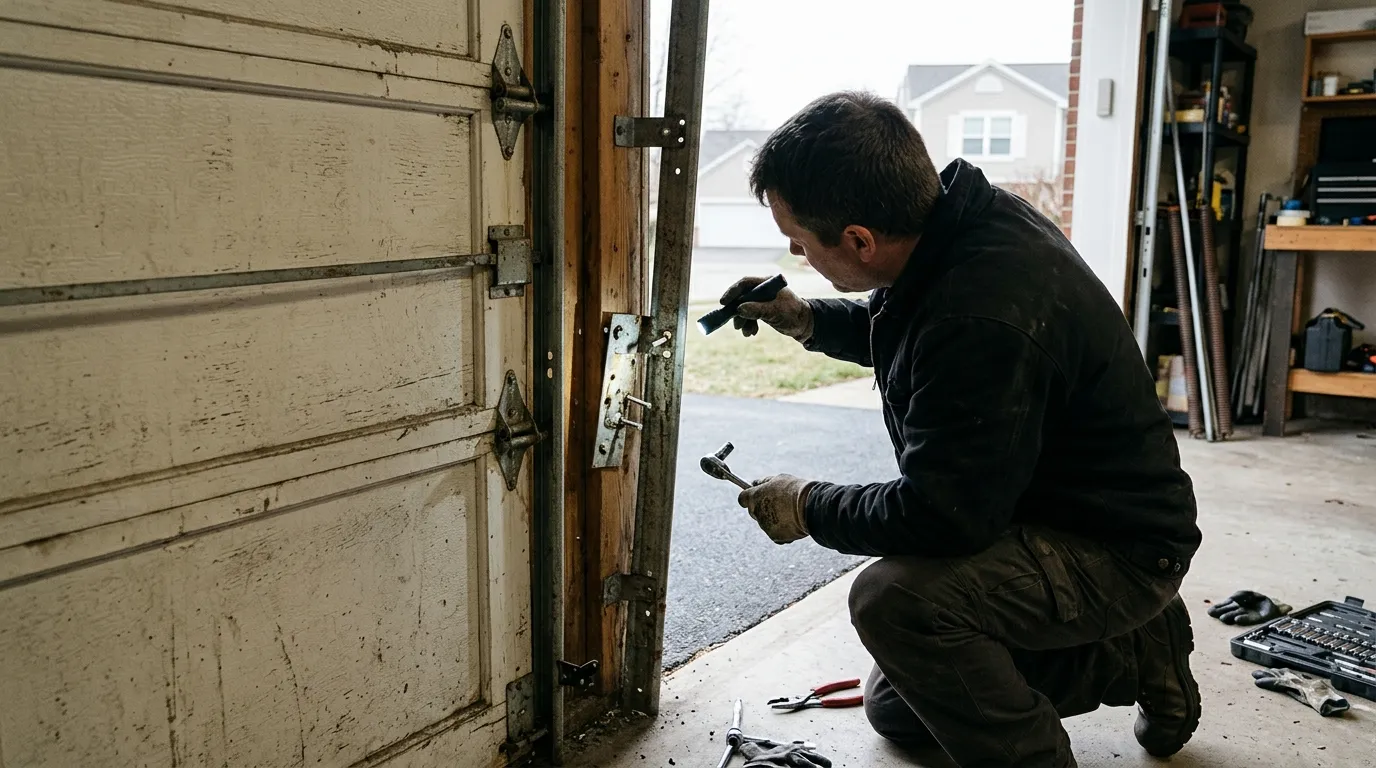
If the door reverses before it touches the floor, or the opener light blinks a set number of times and won't clear after you've wiped both lenses and checked for anything blocking the beam, that's a call, not a project for another weekend. Don't keep forcing the door down by holding the wall button - that bypasses the safety circuit entirely and defeats the reason the sensors exist. If one bracket has visibly separated from the slab, or the sensor wire has been pinched by something rolling past it, that's also past the point of DIY. A five-minute check on your end (clean lenses, clear the beam path, look at bracket angle) is reasonable. Beyond that, a misaligned bracket on a settled slab is a two-person job to get both eyes staring at exactly the same point again.
The Problem
A lot of the housing stock through this area went up between 1938 and 2003, with most of it clustered in the 1960s and '70s across the many subdivisions here. That means a huge share of openers have been replaced at least once since the original build - sensors as a federal requirement came later than most of these houses did - and the replacement units often got mounted onto brackets that were never re-leveled to the current slab position. So you end up with a sensor pair that was aligned correctly the day it was installed, on a slab that has since moved from another decade or two of freeze-thaw. The drift isn't sudden. It's slow enough that most owners don't notice until the door starts reversing at random, and by then they assume the sensor itself is failing rather than the mounting under it.
Where People Go Wrong
The most common mistake is treating a drifting sensor as an electrical problem and swapping the unit before checking the bracket. A brand new sensor bolted to a bracket that's still tilted a few degrees will drift again within a season. The second mistake is over-tightening the wing nuts that hold the sensor to the bracket - crank them down hard and you can warp the thin bracket arm itself, which makes future adjustment harder, not easier. Third, people forget the two sensors have to agree with each other, not with some absolute standard - moving one to compensate for the other just chases the problem back and forth. We'll be honest: if the bracket itself is rusted through or the slab crack under it has gotten wide, realigning it isn't a permanent fix, and at that point replacing the bracket mount is the better use of a call.
Talk to a local pro
Garage door trouble in Naperville?
Same-day service with honest, upfront quotes.